A tiny brain. A remarkable map.
A fruit fly nervous-system map, Beat Saber, Doom and even Bitcoin. What these experiments actually show, and why the map itself is worth exploring.
Take a fruit fly, map its neural connections and put the result online. What happens next? Someone hooks a simulation up to Beat Saber. That is a very internet-shaped ending to a remarkable bit of science. Before getting to the sabers, though, the map itself deserves a look.
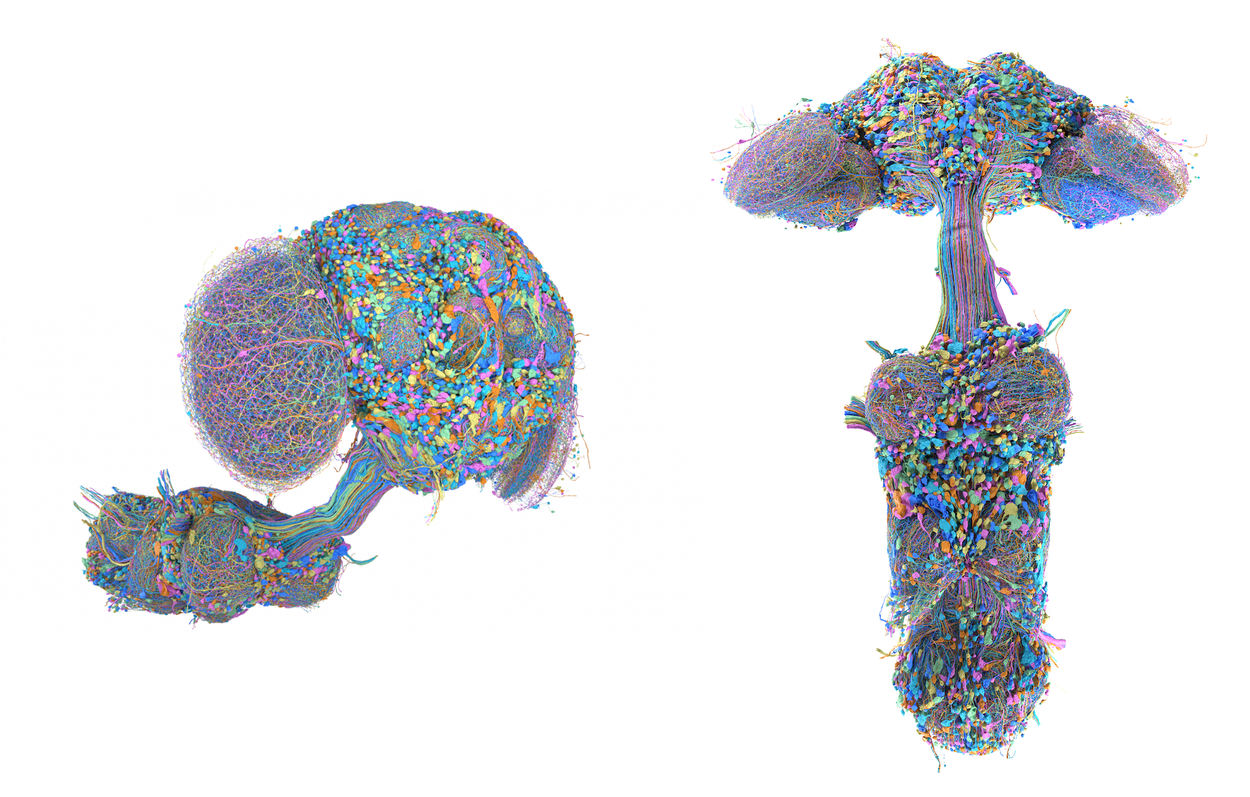
Google Research and its scientific partners helped reconstruct the brain and central nervous system of a male fruit fly: over 166,000 neurons and 125 million synaptic connections. The visualization above shows a selection of cells from that system. Those colorful strands are reconstructed biological structures, all packed into an insect small enough to sit on a piece of fruit.
The work brings together HHMI Janelia, Google Research, the MRC Laboratory of Molecular Biology, the University of Cambridge and other collaborators. It is a collective effort, with a result that is now available for other people to explore. You do not have to settle for the angle chosen for a press image. You can go and look around.
I want to zoom in
This is where it gets particularly good. The map can be rotated and explored in 3D, letting you follow connections that would otherwise be very difficult to picture. Pick a cluster, zoom in and the tidy overview turns into a much more complicated arrangement. Zoom out again and that small detail disappears back into the whole. It is easy to see why someone would keep clicking.
The word for a map like this is a connectome. It describes which neurons connect to which others. That gives researchers a detailed structure to investigate, and gives the rest of us a chance to see what that structure looks like. You can enjoy exploring it before you understand all the labels. There is plenty to look at.
Of course, a map is still a map. It does not automatically become a complete working copy of the animal just because the connections have been reconstructed. There are more questions to answer about how those connections behave. Still, having this much structure available to examine is an extraordinary starting point. It turns hidden detail into data that other people can use.
Taking a closer look
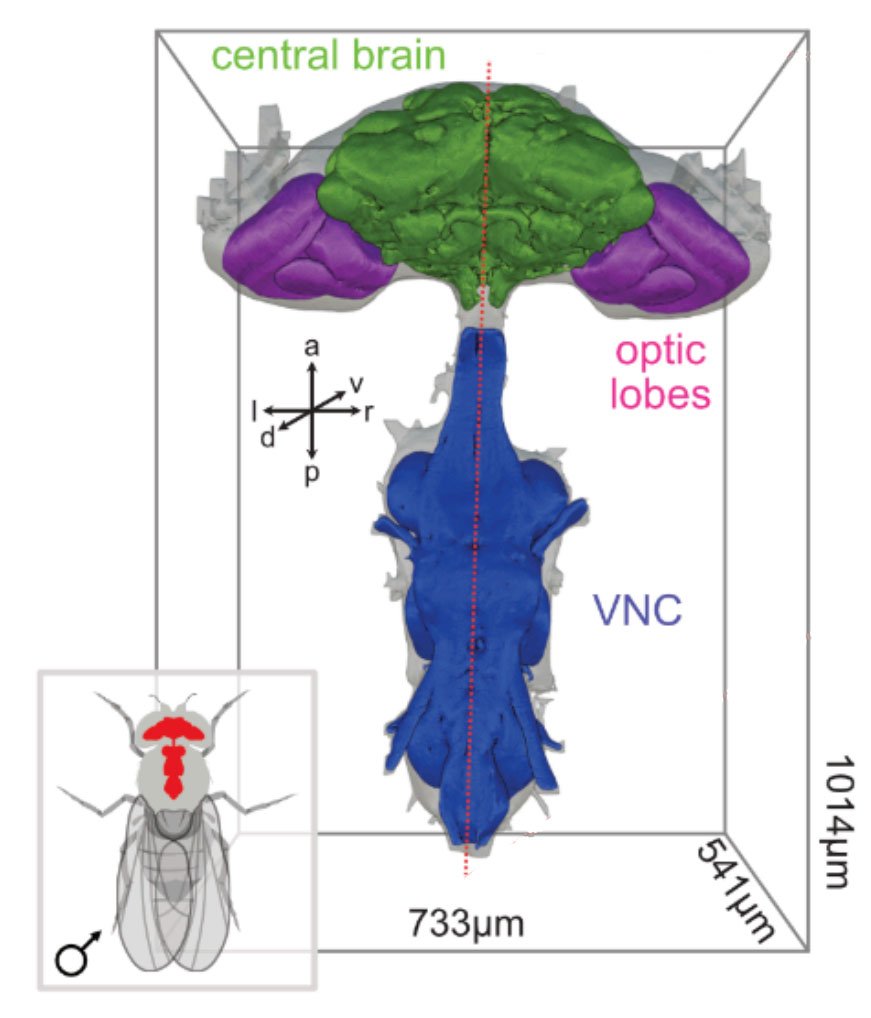
The second diagram makes the scope easier to see. It includes the central brain, the optic lobes and the ventral nerve cord. So the project reaches beyond the brain alone, toward the circuitry connecting it with the body. That broader view is useful when the question is how sensory information ends up contributing to movement.
Getting to these images required more than making a nice 3D model. Google worked on segmenting electron-microscopy images, and human experts checked and annotated the reconstruction. The pictures are the part we get to enjoy immediately. Behind them is the work of deciding which tiny structures belong together and making the result reliable enough to use.
That is what makes an open map like this exciting. A finished visualization is already worth seeing, but the data also gives other people something to build on. Some will ask neuroscience questions. Others will try things the original researchers probably did not put at the top of their list. First, though, there is a useful question: how do we get from connections to movement?
Okay, but what makes it move?
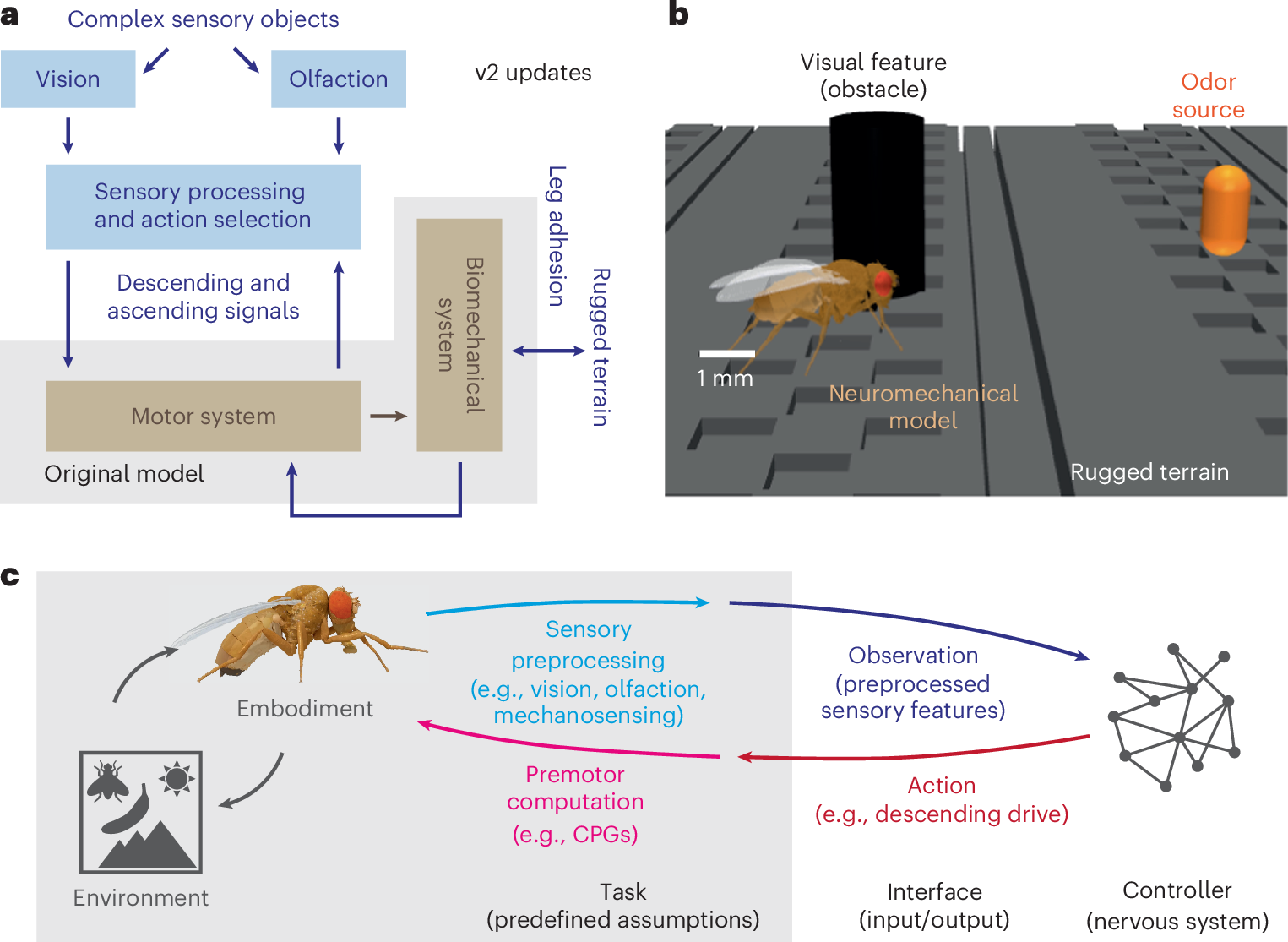
- A: sensory signals inform action selection. Motor commands move the body, and feedback returns from that movement.
- B: the virtual fly faces uneven ground, an obstacle and an odor source. Its body interacts with a simulated environment.
- C: observations go to a controller; actions go back to the body. Movement changes the next observation, so the loop repeats.
The controller is configurable. This figure alone does not show a complete biological brain running the fly.
There is a research use behind all the demos, too. A 2024 computational study used a different, female-brain dataset to predict responses in feeding and antennal-grooming circuits, then tested specific predictions in living flies. That is a much more useful check than a convincing animation: does the model predict something that an experiment can confirm?
And then someone connected it to Beat Saber
A demo shared online connects a fly-brain simulation with Beat Saber, complete with a virtual fly swinging at the blocks. It is a wonderfully odd thing to see next to the research images. The same topic that starts with neurons and microscopy suddenly has a rhythm-game soundtrack. Serious science, curious developers and an idea that is hard to resist trying: can we connect these two things?
There is an important detail to keep with the clip. This is a simulation experiment, not a living insect in VR. Reports of the creator’s explanation describe training around a replay of one song, so the demo should not be read as a fly independently mastering any track it sees. Even with that context, the experiment is fun to watch. The map is impressive; the unexpected things people try with it make the story even better.
Doom, Mario, and then Bitcoin
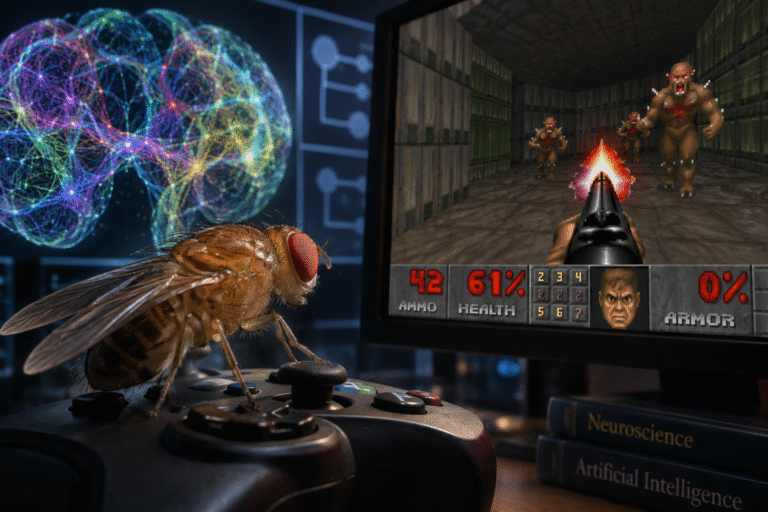
Beat Saber has company. DOOMFLY turns game images into modeled sensory inputs and maps neural activity to controls. Fly64 connects a model to Super Mario 64. Movement is not mastery: DOOMFLY reports unsuccessful learning checks, and Mario can get stuck against a wall.
Stonkfly goes further afield, connecting neural output to buy, sell or hold decisions. It supports real crypto orders, but defaults to paper trading. Its documentation says profitable learning has not been demonstrated. A wonderfully strange experiment; evidence of a fly understanding markets would be quite another thing.
This is the part I want to keep in perspective. The measured wiring is one ingredient. Someone still chooses how game pixels or a price chart become inputs, how the simulated neurons behave, and how their activity becomes a button press or an order. The resulting demo is an engineered system, not an untouched fly mind let loose on a computer.
What comes after the fly?
Fish and mice are already part of this work. Google’s dataset overview lists a draft whole-brain connectome for a larval zebrafish, completed in 2026, alongside recordings of activity from the same animal. That is especially interesting: comparing the wiring with activity, rather than stopping at the structure.
For mice, a project announced in 2023 set a five-year goal of mapping roughly 2-3% of the brain, focused on the hippocampal region. That puts the project’s original horizon around 2028. It is a research target for a small fraction of a mouse brain, not a promised date for a complete one.
And when do we get to a human brain?
Small pieces are already being mapped. The H01 human dataset covers roughly one cubic millimeter of tissue and takes up 1.4 petabytes. A whole human brain is a very different scale. A complete map and a working simulation are also different goals; neither gives us a basis for claiming that a person’s mind has been copied.
So I cannot put an honest date next to a complete human-brain simulation. The sources here do not announce one. The exciting part is the work we can actually point to: fly maps, larval fish and larger mammalian samples. There is a lot happening without pretending we have a release year for a digital human.
One more question worth keeping
Thinking about people also raises a question beyond computing power: who gets access to neural data, and on whose terms? UNESCO adopted a neurotechnology ethics recommendation in 2025 addressing mental privacy and autonomy. That debate does not mean we can already read anyone’s thoughts. It means consent and control over these data deserve attention while the technology develops.
Worth a look
- Google Research: Mapping the complete male fruit fly brain (2026)
- HHMI Janelia: The male fruit fly central nervous system connectome
- NeuroMechFly v2: embodied sensorimotor control
- Google Neural Mapping: open datasets
- Google Research: mapping a mouse brain
- DOOMFLY: implementation and experimental results
- Fly64: how the Mario demo works
- Stonkfly: model and trading limitations
- Shiu et al.: A Drosophila computational brain model (Nature, 2024)
- UNESCO: Ethics of Neurotechnology
- Wszystko co Najważniejsze: muszka, gry i Bitcoin
- Patrick Mineault: Deconstructing viral fly sims